If you are trying to lower your electricity bill, knowing the LESCO peak hours can help you decide when to use high-power appliances such as air conditioners, water pumps, electric heaters, irons, washing machines, and other heavy electrical loads.
LESCO peak hours change during the year. The timing is not the same in December as it is in July, so using an old schedule can give you the wrong idea about when peak electricity consumption is recorded.
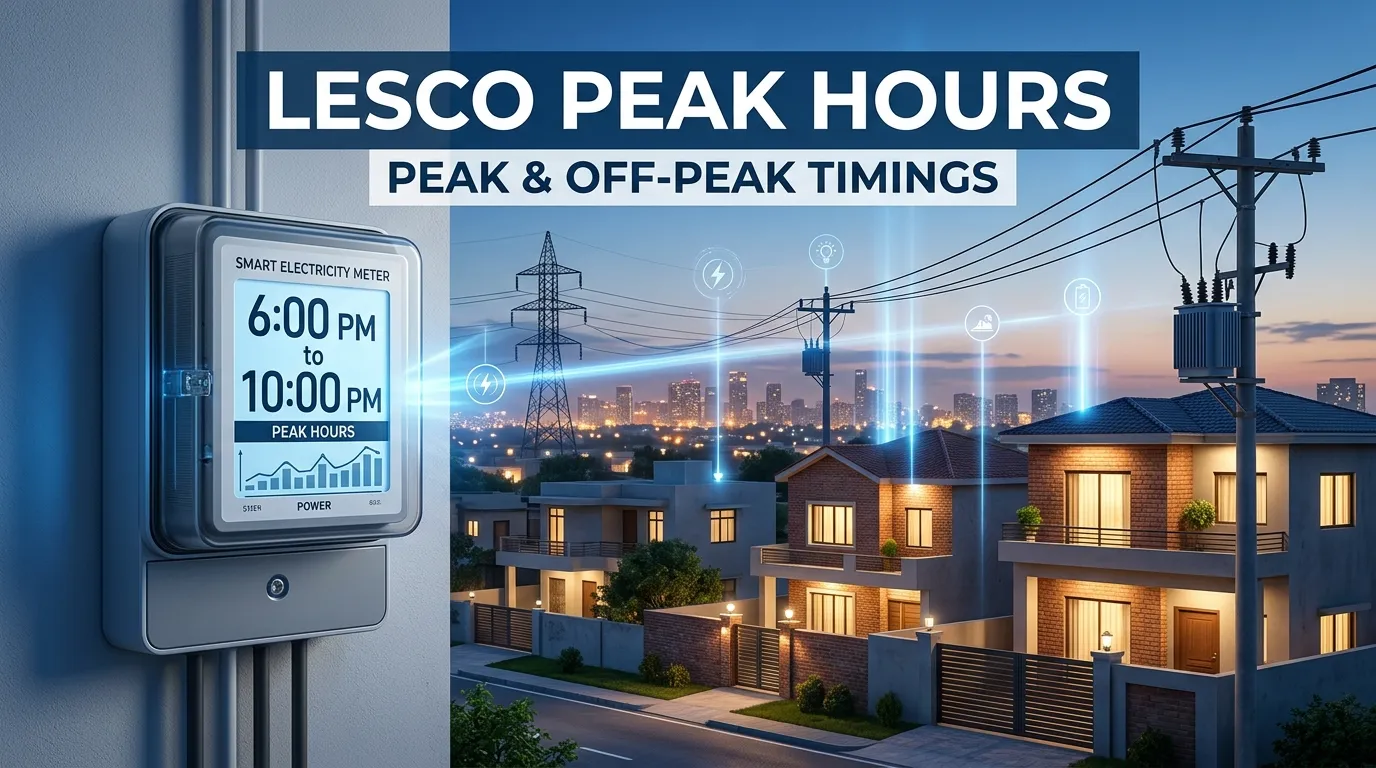
According to the PITC Peak / Off Peak Timings schedule, the applicable seasonal peak period is four hours long. For the current September to November 2026 period, the peak hours are 6:00 PM to 10:00 PM.
The remaining 20 hours of the day fall outside the scheduled peak period.
LESCO Peak Hours at a Glance
The seasonal LESCO peak-hour schedule is shown below:
| Months | Peak Hours | Off-Peak Hours |
|---|---|---|
| December to February | 5:00 PM – 9:00 PM | Remaining 20 hours |
| March to May | 6:00 PM – 10:00 PM | Remaining 20 hours |
| June to August | 7:00 PM – 11:00 PM | Remaining 20 hours |
| September to November | 6:00 PM – 10:00 PM | Remaining 20 hours |
Current LESCO Peak Hours: September to November 2026
For September, October, and November 2026, the scheduled LESCO peak period is:
6:00 PM to 10:00 PM
This means the four-hour period from 6 PM until 10 PM is the current seasonal peak window. If your electricity connection is billed under a time-of-use arrangement, this is the period you should pay particular attention to when planning the use of high-energy appliances.
What Are LESCO Peak Hours?
LESCO peak hours are the scheduled hours when electricity consumption is treated as peak consumption under applicable time-of-use arrangements.
Electricity demand generally increases during the evening as people return home, switch on lights, operate cooling appliances, use water pumps, cook, and perform other household activities.
Time-of-use billing distinguishes between peak and off-peak consumption. The exact effect on your bill depends on the tariff applicable to your connection.
The important point is that the scheduled peak period is only four hours long. It does not mean that the entire evening or the whole day is classified as peak.
LESCO Peak Hours by Season
One reason people find different LESCO peak-hour timings online is that the schedule changes according to the season.
December to February
During the winter months, the peak period is:
5:00 PM to 9:00 PM
The remaining 20 hours are outside the scheduled peak window.
March to May
From March through May, the peak period is:
6:00 PM to 10:00 PM
June to August
During June, July, and August, the peak period moves later:
7:00 PM to 11:00 PM
This is the seasonal schedule generally associated with the summer months.
September to November
From September through November, the timing moves back to:
6:00 PM to 10:00 PM
Therefore, if you are checking the LESCO peak hours in September, October, or November 2026, the scheduled peak window is 6 PM to 10 PM.
What Are LESCO Off-Peak Hours?
Off-peak hours are the hours outside the scheduled four-hour peak period.
For the September-November schedule:
- Peak: 6:00 PM – 10:00 PM
- Outside the peak window: 10:00 PM – 6:00 PM
This includes the morning, afternoon, and late-night hours. When the seasonal peak period changes, the hours outside that window change accordingly.
Do LESCO Peak Hours Apply Every Day?
The PITC seasonal timetable defines the peak period by season and does not list a separate weekday and weekend schedule.
Consumers using a time-of-use arrangement should therefore not assume that Saturday, Sunday, or a public holiday automatically removes the peak period.
For the September-November schedule, the listed peak window is 6:00 PM to 10:00 PM.
Does Everyone Pay a Higher Rate During LESCO Peak Hours?
Not necessarily. This is an important distinction when discussing LESCO peak hours.
Peak and off-peak billing is relevant to consumers whose tariff or meter records electricity consumption according to time of use.
If your connection is billed under an ordinary consumption-slab structure rather than a time-of-use arrangement, using electricity at 8 PM does not automatically mean that the unit is charged under a separate peak rate.
How to Check Your Meter and Bill
Look at the consumption section of your electricity bill.
If your bill records separate peak and off-peak units, your connection is recording consumption according to different time periods.
If your bill shows only one total consumption figure under your applicable billing structure, you may not be on a peak/off-peak tariff.
If you are unsure, check the tariff information printed on your bill or contact LESCO for confirmation.
Why Do LESCO Peak Hours Matter?
For consumers on time-of-use tariffs, the timing of electricity consumption can affect the energy charges on the bill.
A household may consume the same total number of units in a month but have a different distribution between peak and off-peak hours.
For example, if a household regularly operates a water pump, iron, and washing machine during the evening peak period, moving some of that usage to another time may reduce the amount of electricity recorded during peak hours.
The basic idea is simple:
You do not always have to use less electricity to reduce peak consumption. You can also change when you use it.
Which Appliances Should You Use Outside Peak Hours?
Large electrical appliances can consume considerably more electricity than smaller household devices. Where practical and safe, some activities can be scheduled outside the peak period.
- Water pumps
- Washing machines
- Electric irons
- Electric geysers
- Water heaters
- Electric ovens
- High-power kitchen appliances
- Battery charging
- Other high-load electrical equipment
For example, if you normally operate your washing machine at 8 PM during the September-November peak period, you could move it to the afternoon or after 10 PM when your routine allows.
What About Air Conditioners?
Air conditioners are among the largest electricity-consuming appliances in many Pakistani homes, particularly during hot weather.
Avoiding AC use completely during peak hours is not always practical. Instead, households can focus on using their AC efficiently.
- Keep doors and windows properly closed while the AC is operating.
- Clean AC filters regularly.
- Avoid unnecessarily low temperature settings.
- Use a sensible temperature setting.
- Pre-cool rooms before peak hours when practical.
- Avoid cooling empty rooms.
- Consider energy-efficient appliances when replacing older units.
For a household with a time-of-use meter, reducing unnecessary AC consumption during the peak window can be particularly useful.
Does Using Electricity at Night Always Mean a Lower Bill?
Not necessarily. The answer depends on your electricity tariff and how your meter records consumption.
For a time-of-use consumer, the hours outside the designated peak window are the off-peak period. However, consumers should not assume that every LESCO connection is billed using the same peak and off-peak structure.
Your electricity bill is the best starting point for determining how your own connection is being charged.
LESCO Peak Hours and Three-Phase Meters
Three-phase connections are commonly used for larger residential, commercial, and other electrical loads, and some such connections use time-of-use metering.
However, having a three-phase meter by itself should not be treated as proof that your bill uses peak and off-peak rates.
The important question is whether your connection is billed under a time-of-use tariff and whether your meter records peak and off-peak consumption separately.
If your bill shows separate peak and off-peak readings, the seasonal timing becomes directly relevant to your electricity charges.
LESCO Peak Hours vs. Load Shedding
Peak hours and load shedding are not the same thing.
Peak hours refer to the scheduled period used for peak/off-peak tariff or consumption classification.
Load shedding refers to an interruption or planned reduction in electricity supply.
A feeder may experience an outage during a particular period, but that outage does not itself define the official LESCO peak-hour schedule.
Similarly, temporary government demand-management measures should not automatically be confused with the regular seasonal peak/off-peak tariff timetable.
Are LESCO Peak Hours the Same Throughout Pakistan?
Not necessarily.
Different electricity distribution companies can have their own applicable tariff arrangements, while K-Electric has its own tariff structure for Karachi.
Therefore, people searching for WAPDA peak hours should be careful about applying one schedule to every electricity consumer in Pakistan.
For LESCO consumers, use the applicable LESCO/PITC information and your own electricity bill rather than relying on an old social media post.
How Much Can You Save by Avoiding Peak Hours?
There is no single saving amount that applies to every LESCO customer.
The potential difference depends on several factors, including:
- Your tariff category
- Whether your connection uses time-of-use billing
- Your peak consumption
- Your off-peak consumption
- The applicable electricity rates
- Taxes, adjustments, and other charges
For this reason, claims that avoiding peak hours will automatically cut your bill by a specific percentage can be misleading.
A better approach is to check your actual peak and off-peak units and compare the applicable rates shown on your bill.
Simple Example of Shifting Electricity Usage
Suppose a consumer has a time-of-use meter and normally operates several high-power appliances between 6 PM and 10 PM.
Instead of running everything during this period, the household moves some flexible activities to the morning, afternoon, or after 10 PM.
The total number of units consumed may remain similar, but fewer units are recorded during the peak period.
If the applicable peak rate is higher than the off-peak rate, shifting those units can reduce the energy-charge portion of the bill.
The actual saving depends on the rates applicable to that particular consumer.
How to Check Your LESCO Bill Online
Before changing your electricity routine, check your latest bill and see how your consumption is being recorded.
You can use LESCO Bill Check to check your electricity bill online and review important billing information such as consumption, bill amount, due date, and other details.
Check your latest LESCO bill online
Tips to Reduce Electricity Consumption During Peak Hours
You do not necessarily need to change your entire daily routine. A few practical adjustments can help reduce unnecessary peak consumption.
1. Run the Water Pump Before or After Peak Hours
If your water tank allows it, schedule pumping outside the peak window.
2. Move Ironing to the Afternoon
Ironing can usually be shifted because it does not need to be performed at a particular time.
3. Schedule Laundry Outside Peak Hours
Run the washing machine in the morning, afternoon, or after the peak period where practical.
4. Avoid Unnecessary Appliance Use
Turn off appliances that are not being used instead of leaving them running during peak hours.
5. Use Your AC Efficiently
Good insulation, clean filters, sensible temperature settings, and avoiding unnecessary cooling can reduce electricity consumption.
6. Check Your Bill Every Month
Do not rely only on assumptions. Compare your consumption from one billing cycle to another and check your peak and off-peak readings where applicable.
What Are the Current LESCO Peak Hours in 2026?
For September to November 2026, the scheduled LESCO peak period is:
6:00 PM to 10:00 PM
The remaining 20 hours fall outside the scheduled peak window.
| Season | LESCO Peak Hours |
|---|---|
| December – February | 5:00 PM – 9:00 PM |
| March – May | 6:00 PM – 10:00 PM |
| June – August | 7:00 PM – 11:00 PM |
| September – November | 6:00 PM – 10:00 PM |
Because electricity tariffs and schedules can be revised, consumers should check the latest official information when making decisions about their electricity bills.
Frequently Asked Questions About LESCO Peak Hours
What are LESCO peak hours right now?
For the September-November 2026 season, the scheduled LESCO peak hours are 6:00 PM to 10:00 PM.
What are LESCO peak hours in summer?
For June, July, and August, the scheduled peak period is 7:00 PM to 11:00 PM.
What are LESCO peak hours in winter?
From December through February, the scheduled peak period is 5:00 PM to 9:00 PM.
What are LESCO peak hours from March to May?
The scheduled peak period from March through May is 6:00 PM to 10:00 PM.
What are LESCO off-peak hours?
Off-peak hours are the remaining 20 hours outside the four-hour seasonal peak window.
Are LESCO peak hours the same every month?
No. The scheduled peak period changes seasonally. It is 5 PM-9 PM in December-February, 6 PM-10 PM in March-May, 7 PM-11 PM in June-August, and 6 PM-10 PM in September-November.
Do peak hours affect every LESCO customer?
Not necessarily. The peak/off-peak distinction is particularly relevant to consumers whose tariff and meter operate under a time-of-use arrangement. Check your bill to see how your electricity consumption is recorded.
Does using electricity at 8 PM always cost more?
Not for every customer. It depends on the applicable tariff and whether your connection is billed using peak/off-peak time-of-use rates.
Is 10 PM an off-peak time in September?
The scheduled peak period ends at 10 PM during September-November, so the period after 10 PM falls outside the scheduled peak window.
Can LESCO peak hours change?
Electricity tariffs and applicable schedules can be revised. It is therefore better to confirm the latest information from official electricity-sector sources and your current bill rather than relying on an old article or social media post.
Final Thoughts
Knowing the LESCO peak hours can make electricity consumption easier to manage, particularly if your connection uses time-of-use billing.
For September, October, and November 2026, the scheduled peak period is 6 PM to 10 PM. From December, the timetable moves earlier to 5 PM to 9 PM.
The easiest strategy is not necessarily to stop using electricity during these hours. Instead, look at the appliances you can comfortably operate at another time. Moving flexible loads such as water pumping, washing, ironing, and other high-power activities outside the peak window can help you manage peak consumption.
Most importantly, check your own electricity bill. Your tariff category and meter configuration determine whether peak and off-peak timing directly changes the way your electricity charges are calculated.
Official LESCO Peak and Off-Peak Timings
For the latest official peak and off-peak timetable, you can check the PITC website:
Watch: Peak and Off-Peak Electricity Hours
Want to check your latest electricity bill? Visit LESCO Bill Check to check your bill online.